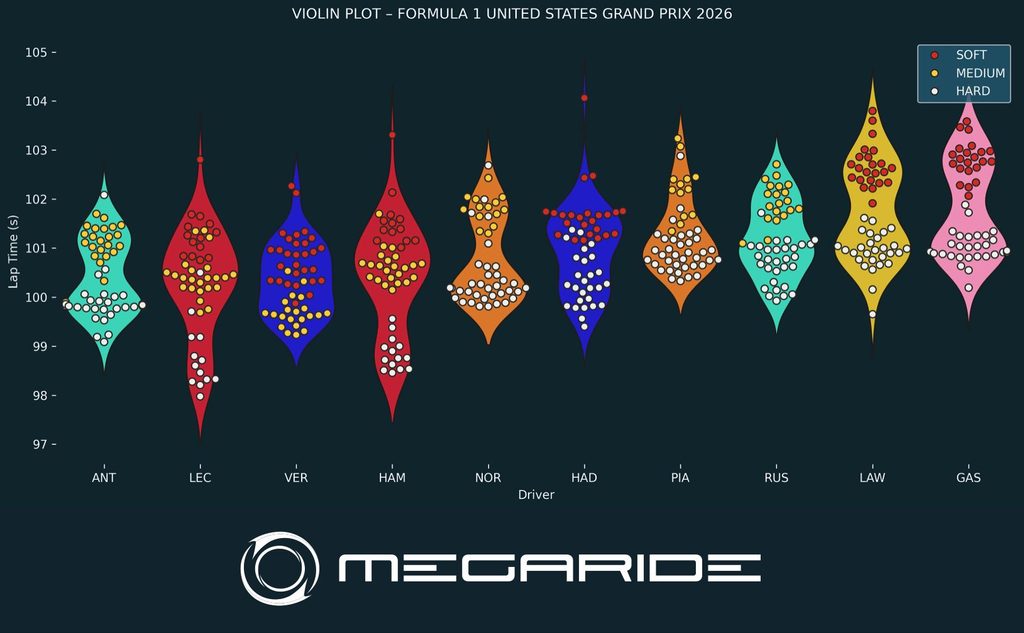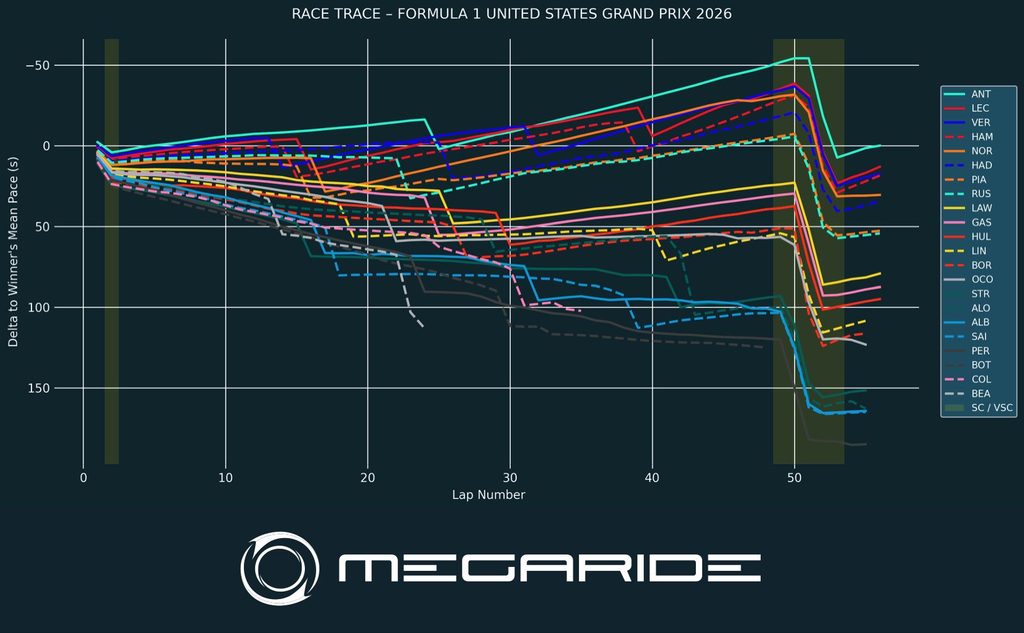
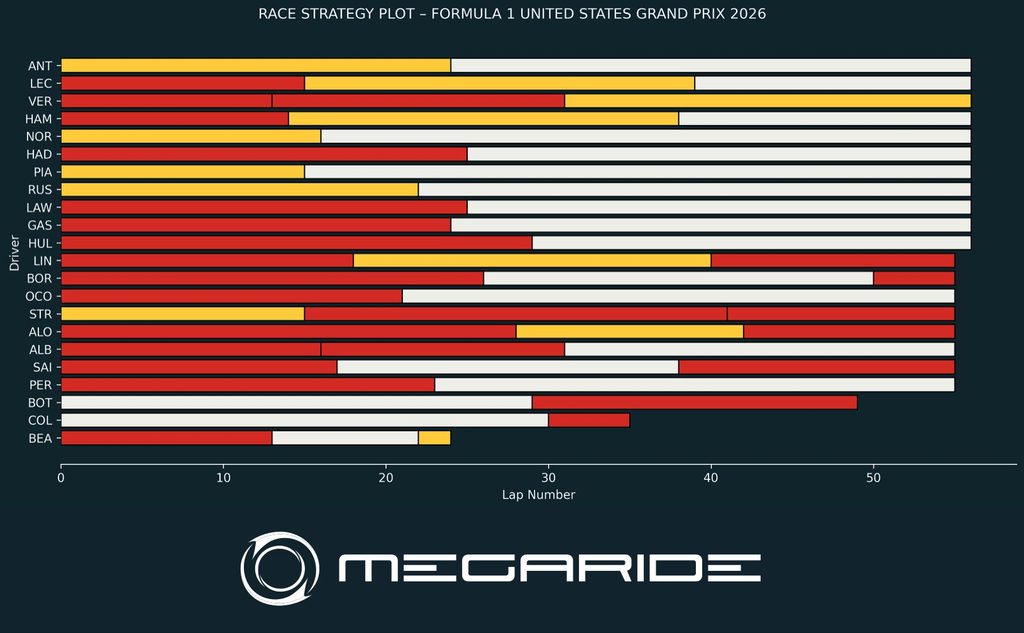
Antonelli won in Austin with a Medium–Hard one-stop and a 32-lap final stint on the C2. Leclerc and Verstappen, both on two stops, finished 13s and 17s behind. The first part of the race was already going Mercedes’ way: Antonelli had nearly 3s over Verstappen by Lap 10 despite starting on the Medium against his rival’s Soft. Red Bull brought Verstappen in around Lap 14; Antonelli stayed out until the end of Lap 24.
On the fuel-corrected traces, Antonelli’s first stint rises from about 1:36.8 to 1:39.1, with a fitted slope near +0.10 s/lap. The Hard stint is noticeably flatter, around +0.06 s/lap over 32 laps, equivalent to approximately 1.9s of lap-time drift. The fuel correction removes an estimated fuel-load contribution, not traffic, tire management, or changing track conditions, so neither slope should be treated as an isolated degradation coefficient.
Verstappen’s second Soft stint runs closer to +0.14 s/lap over 18 laps, versus roughly +0.08 s/lap on the final Medium. The Soft was not delivering a sustained advantage. Red Bull also reported debris damage and balance problems, which makes a purely compound-based explanation impossible. The two-stop still brought him back towards the front, but not close enough to challenge Antonelli.
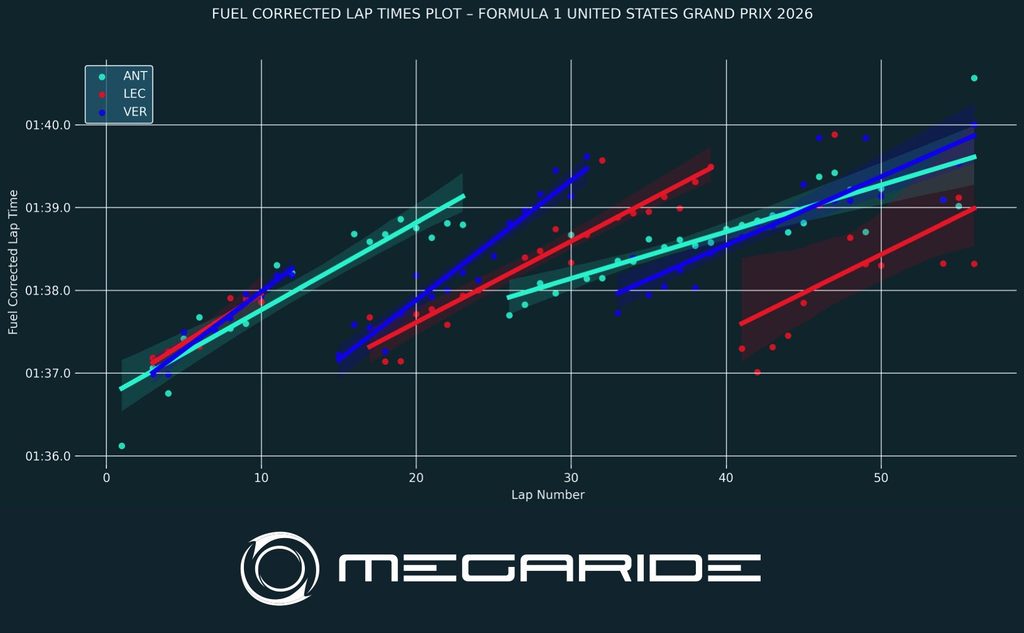
Ferrari made better use of the final tire change. Leclerc switched to Hard after Lap 39, recorded the fastest lap in 1:37.976 on Lap 42, and passed Norris and Verstappen for second. Hamilton moved ahead of Norris as well and finished only 1.030s behind Verstappen; the late VSC halted his attempt at P3.
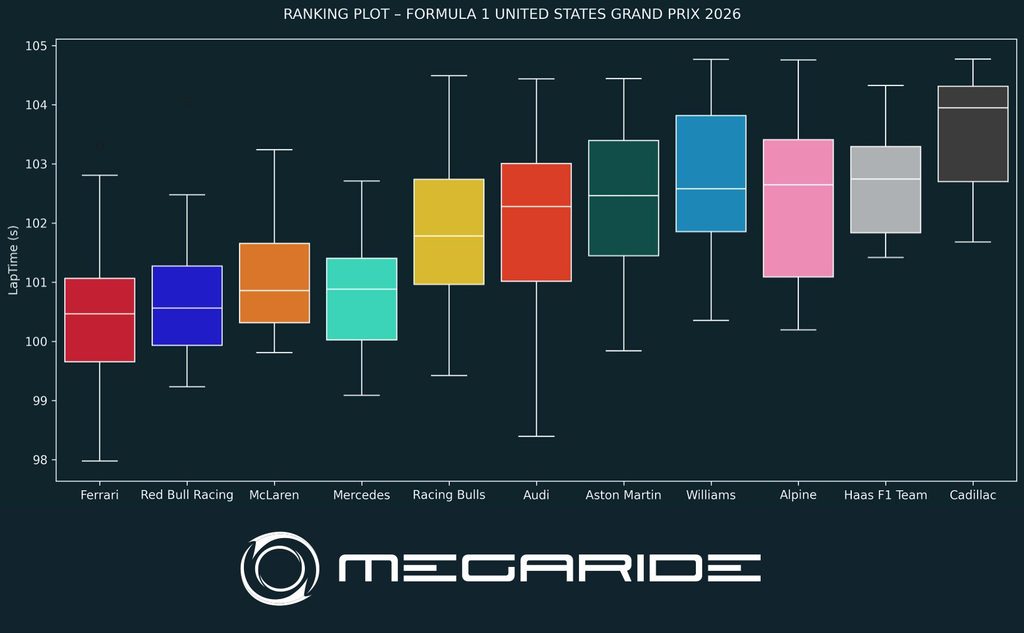
The ranking and violin plots add some context. Ferrari and Red Bull sit around 1:40.5–1:40.6 in median team lap time, with Mercedes nearer 1:40.9. Those samples combine two drivers and different stints: they should not be read as a clean comparison of car potential. Leclerc’s late Hard laps reach below 1:39, while most of his early Soft laps are above 1:40. Fuel load and stint timing matter more to that raw comparison than the colour of the tire.
Norris went Medium–Hard as well, but stopped after 16 laps and asked for the Hard to cover 40. He finished fifth, 30s behind Antonelli, after losing positions to drivers on fresher tires. Same nominal strategy, very different tire-age profile.
Pirelli found relatively high physical wear without a comparable rise in performance degradation, and the Hard worked better than expected. The distinction matters: material loss at the tread does not translate directly into the same loss of available lap-time performance. At COTA, Antonelli had enough pace left on the Hard to make the additional pit stop unnecessary.