Race result
Kimi Antonelli took his maiden F1 win in Shanghai and led a Mercedes one-two ahead of George Russell, with Lewis Hamilton completing the podium for Ferrari.
Tires and strategy
Shanghai once again stressed the front-left, and the race was shaped more by tire control than by extreme degradation. The Safety Car pushed most of the field toward a one-stop race, with a long final stint on Hard.
Ranking plot
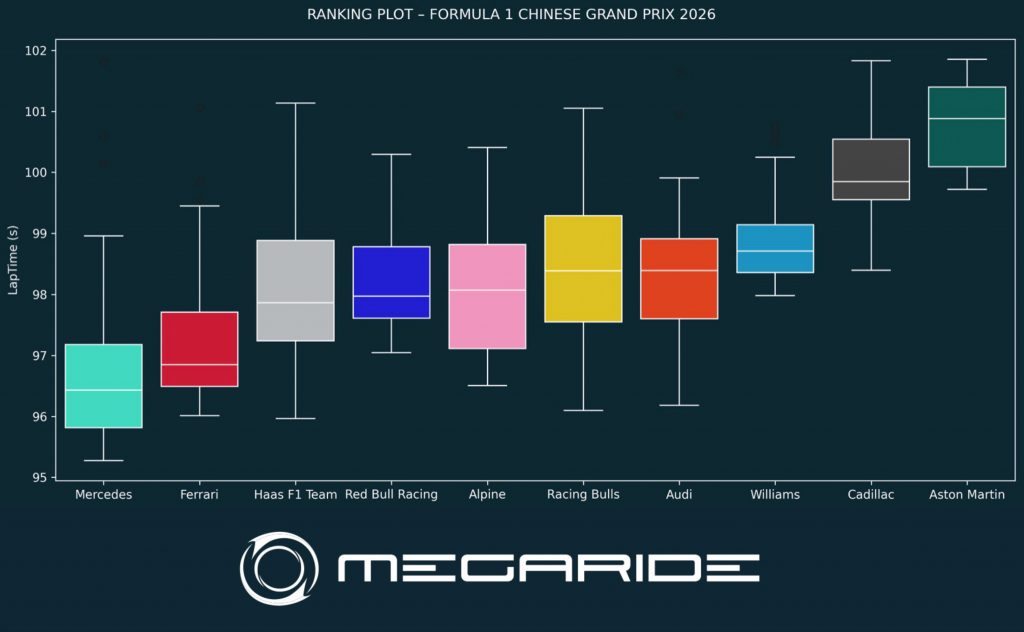
The ranking plot provides a clear view of the order. Mercedes was clearly quickest, with Ferrari roughly +0.4s on median lap time. Then came a very tight group with Haas, Red Bull, and Alpine, all in the +1.4s to +1.6s window. Racing Bulls, Audi, and Williams followed at around +2.0s to +2.3s, with Cadillac and Aston Martin further back.
Violin plot
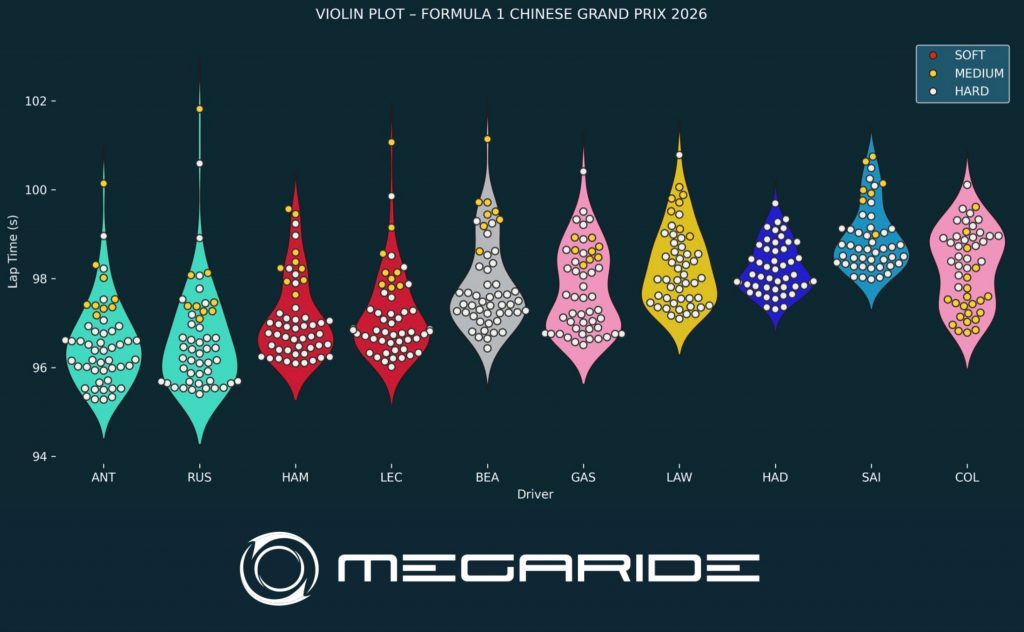
The violin plot adds more detail to the stint picture. On Hard, Mercedes appears roughly 0.3 seconds faster than Ferrari under comparable conditions. On Medium, the spread is much wider, so the comparison is less robust.
Bearman stands out in a very positive way, with a race pace only slightly slower than Ferrari over long phases of the race. Gasly was also very solid for Alpine. Colapinto is interesting as well, as the offset strategy gave him a stronger late-race phase.
Fuel-corrected lap time
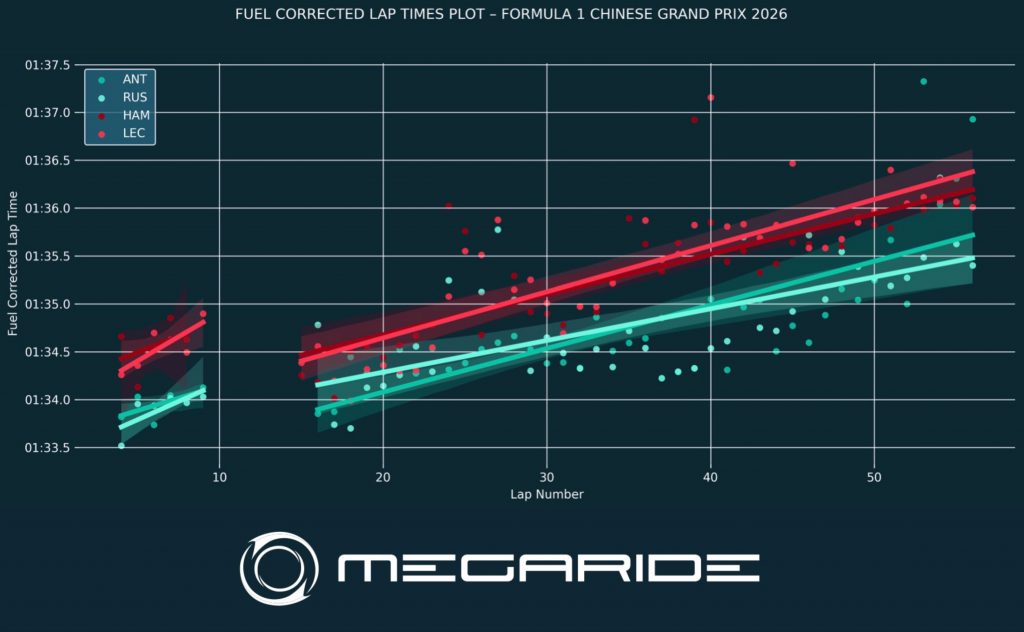
The fuel-corrected plot is probably the clearest indicator of the real pace picture. Before and after the Safety Car, Mercedes looks roughly 0.5s per lap quicker than Ferrari overall. That matters because it suggests the gap was not only created by traffic or wheel-to-wheel fighting, but by a genuine underlying pace advantage.
Race gapper
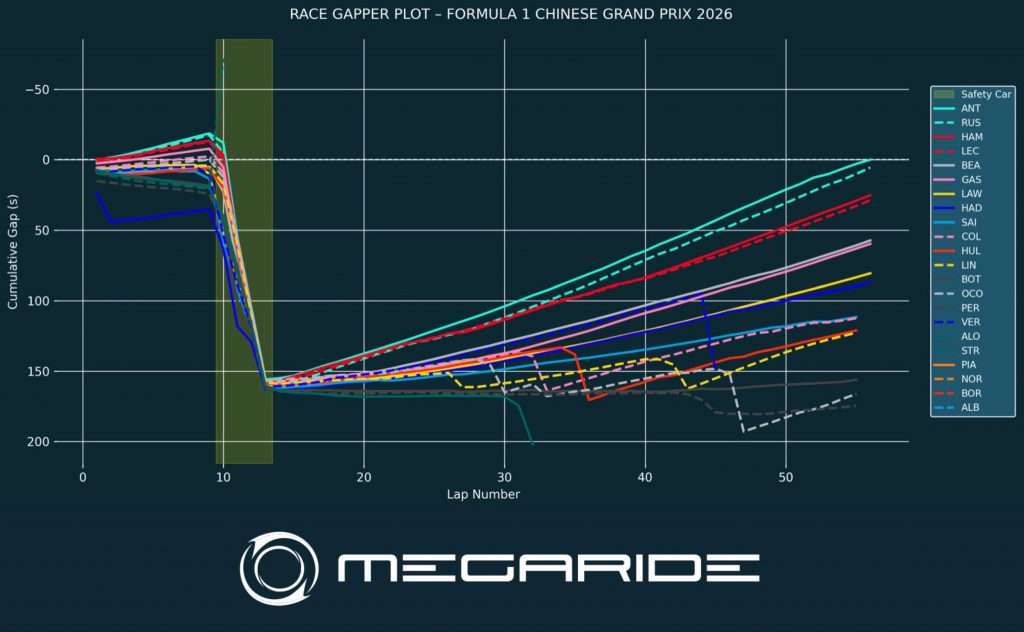
The race gapper helps explain how that advantage turned into the final result. After the Safety Car, Russell and the two Ferraris lost time battling each other, while Antonelli could build a margin at the front. Once Russell cleared that phase, his slope became much closer to Antonelli’s, confirming that both Mercedes had very similar long-run speed.
Ferrari’s battle clearly cost some time, but even beyond that, the second-stint gradients suggest there was not much room to respond on pure pace.
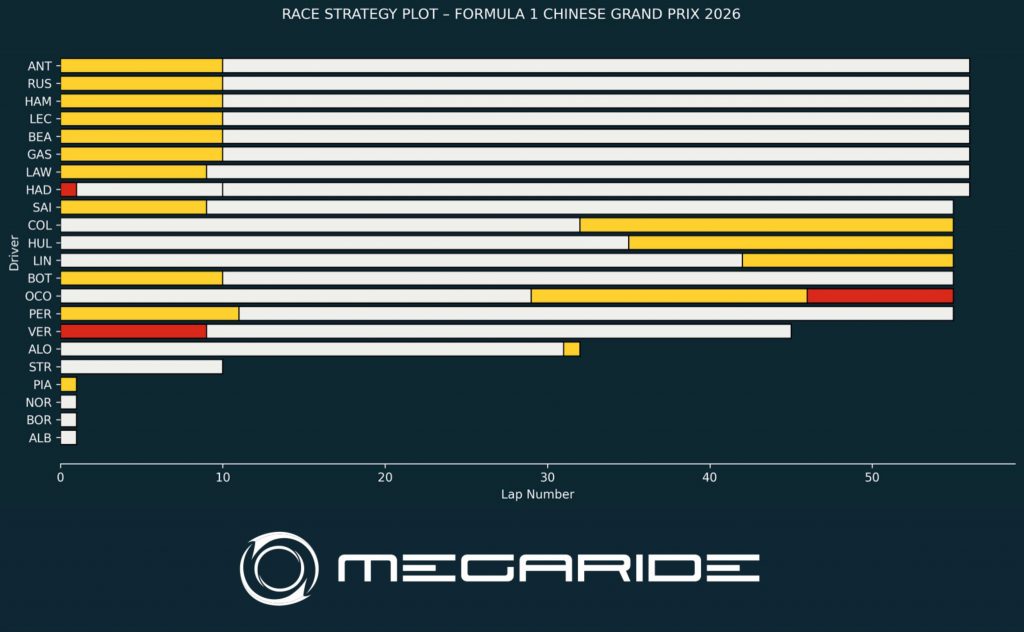
Midfield and attrition
Behind the top four, Bearman and Gasly were the standout performers. Cadillac did not score points, but having both cars at the finish is still a useful step this early in the program. The race was also heavily influenced by attrition, with McLaren not even making the start, and several retirements reducing the field.
Takeaway
This was not only a race won on execution. The data trends point in the same direction: Mercedes had the stronger package, managed the tires better, and had enough pace to control the race once it settled.