The first Grand Prix of the new era made one point clear: with the 2026 power unit built around a stronger electrical contribution and a near 50/50 electric-thermal split, performance is no longer defined only by car balance, aero efficiency, and tire behaviour.
In Melbourne, race execution was heavily shaped by harvesting, deployment timing, and battery state. At times, it looked more like energy management than pure pace.
Race result
Mercedes executed the new formula best. Russell converted pole into victory and led a Mercedes 1-2, with Ferrari following through Leclerc and Hamilton in P3 and P4. Norris and Verstappen were clearly further back.
Race pace picture
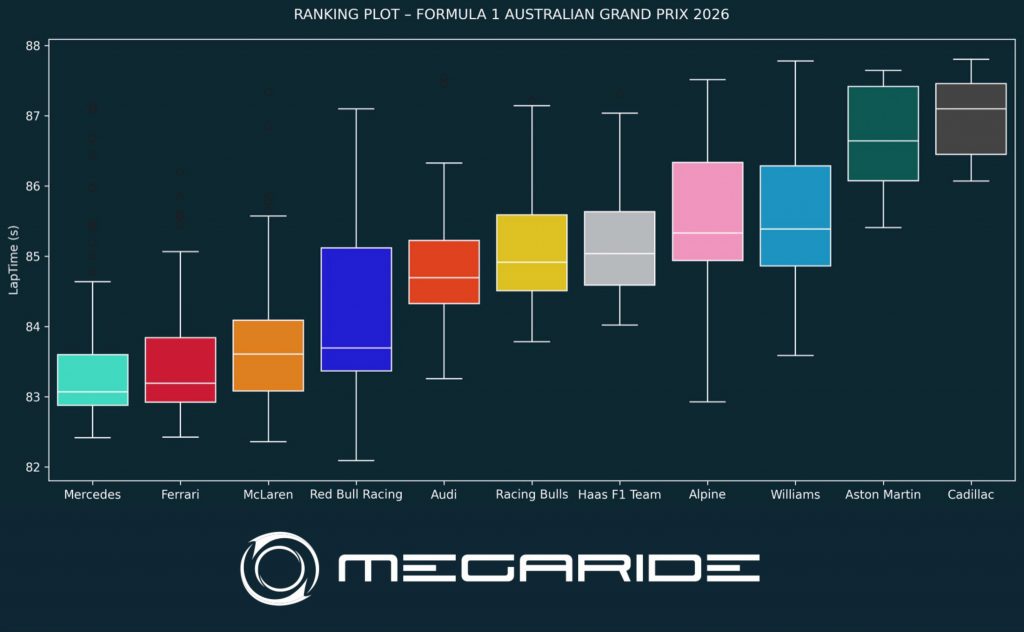
The ranking plot is revealing: Mercedes had the strongest package, but Ferrari was much closer than qualifying suggested. On Saturday, the gap to Russell was over 0.8 seconds; on Sunday, it was much smaller in race trim. Behind the leading pair, McLaren and Red Bull looked more detached, while Audi appeared competitive in the midfield.
Violin plot
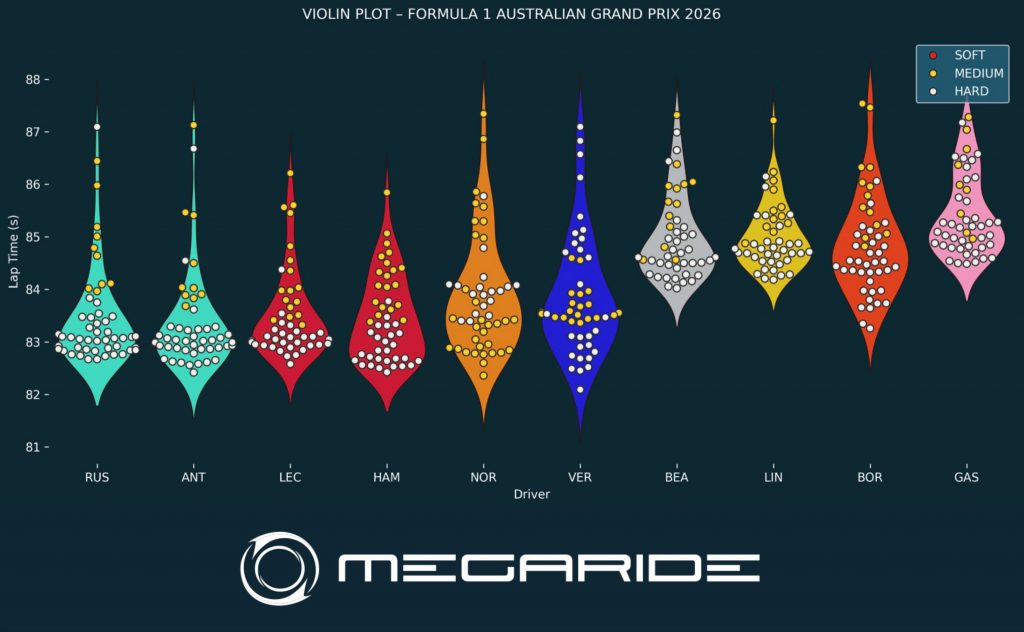
Mercedes and Ferrari show broadly comparable lap time distributions, but Mercedes looked stronger in the second half. Russell was able to lap in the same window as the Ferraris despite older tires, a strong sign of tire robustness and energy control.
Gapper plot and strategy
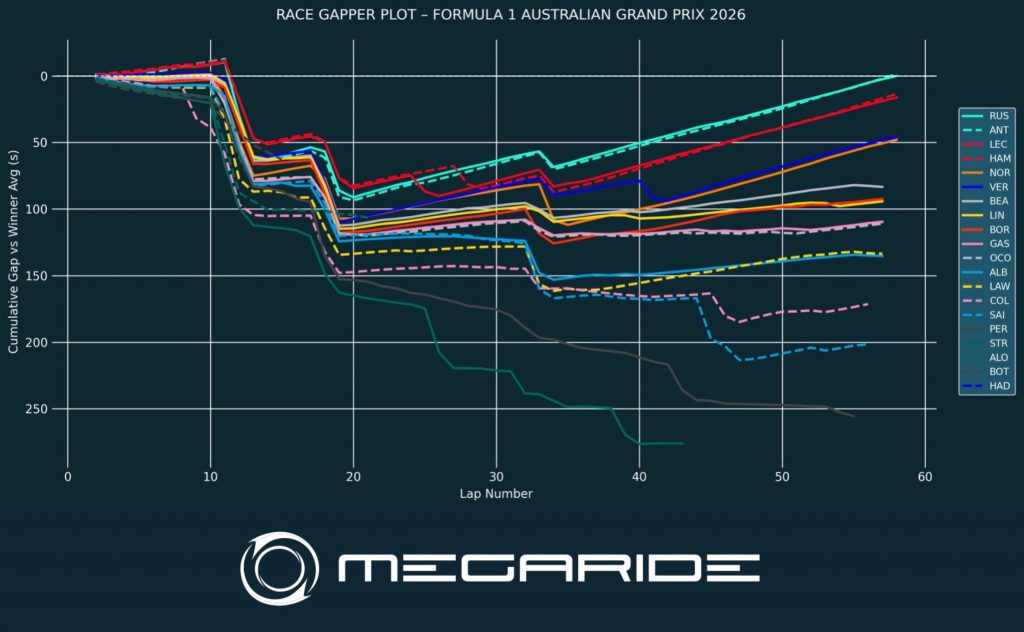
For much of the race, Mercedes and Ferrari were operating at a similar underlying level. The first VSC was decisive: Mercedes boxed, Ferrari stayed out, and a large share of the final gap was created there.
Tire behaviour
Degradation was lower than expected, the one-stop became the baseline strategy, and graining remained manageable. The front-left was the limiting corner, but the hard tire was robust enough for a long final stint.

Fuel-corrected lap time
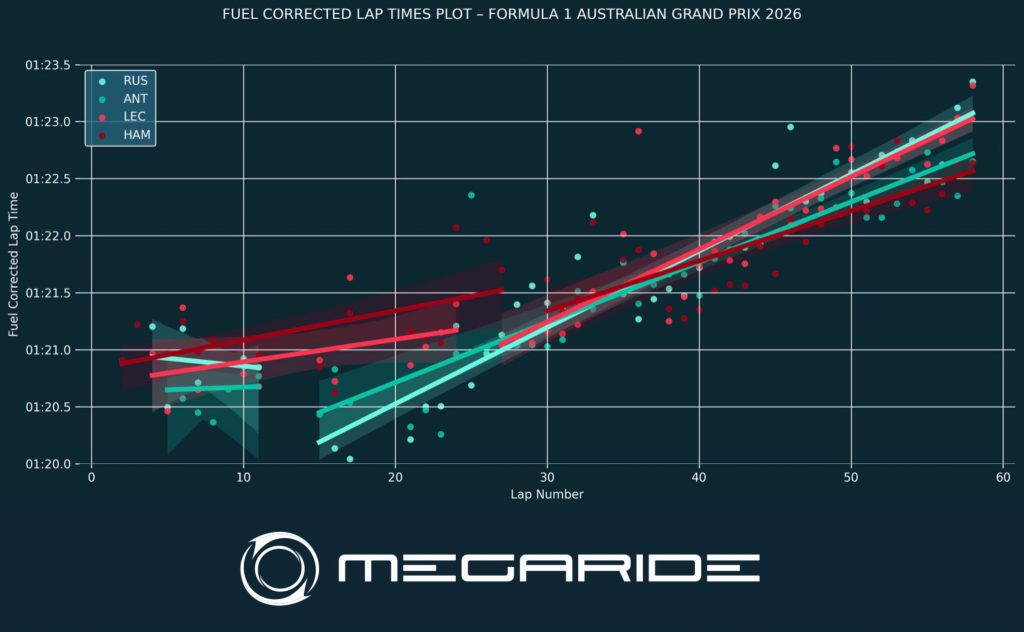
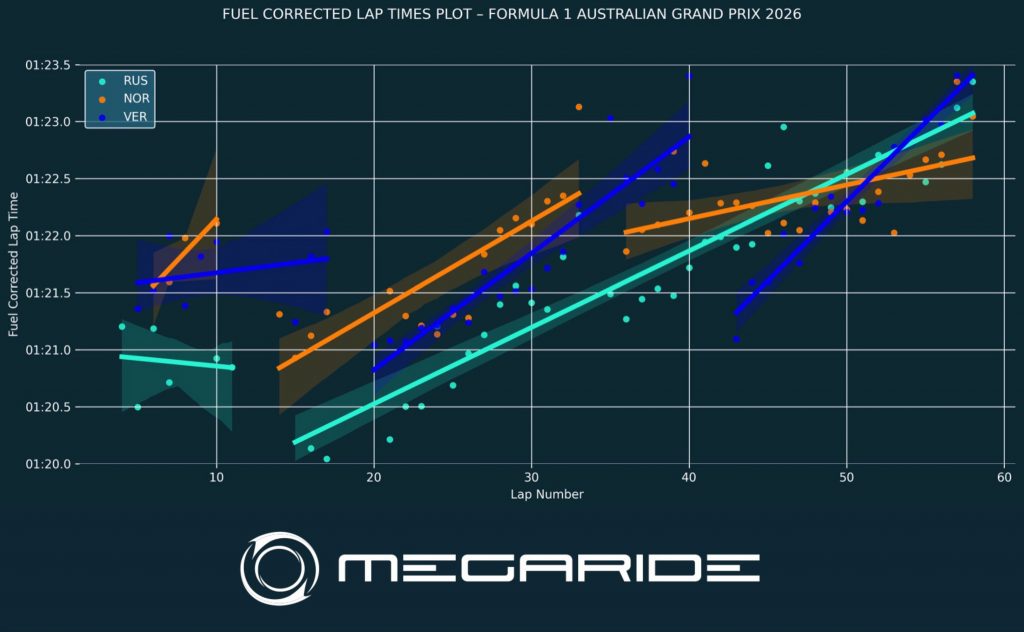
Ferrari lost a large part of the race by extending the first stint, while the second was much more competitive, with Hamilton showing a strong trend. Against Norris and Verstappen, Russell’s advantage was much more pronounced: in stint 1, he was already >0.5s/lap quicker than Norris, and in stint 2, that gap grew to nearly 1.0s/lap. Against Verstappen, the advantage ranged from 0.5s/lap to 1.0s/lap depending on the stint phase.
Takeaway
Melbourne showed that in 2026, performance is about how well teams integrate tire behaviour, long-run balance, harvesting, deployment, and strategy under neutralisations.
In Australia, Mercedes set the benchmark.