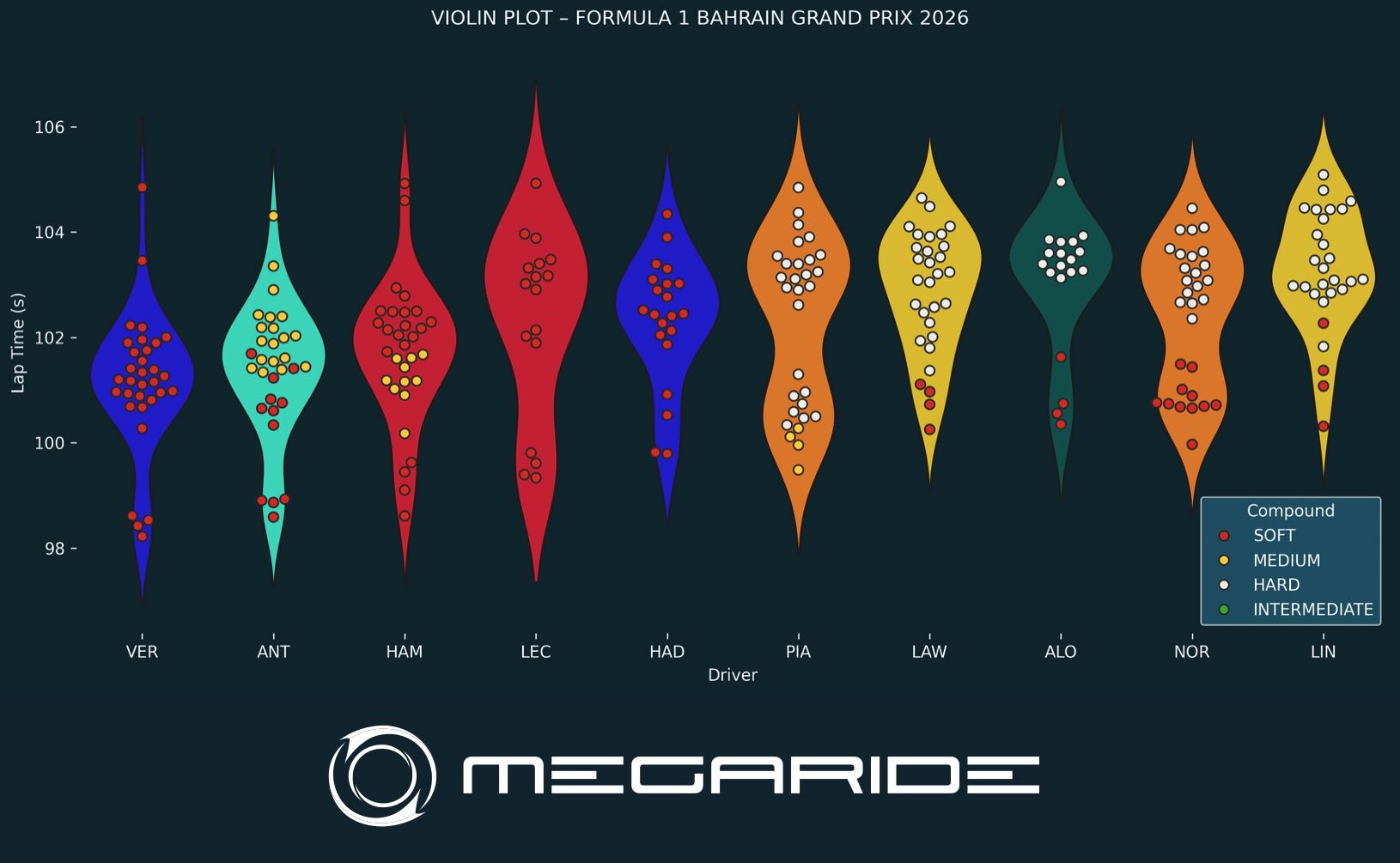
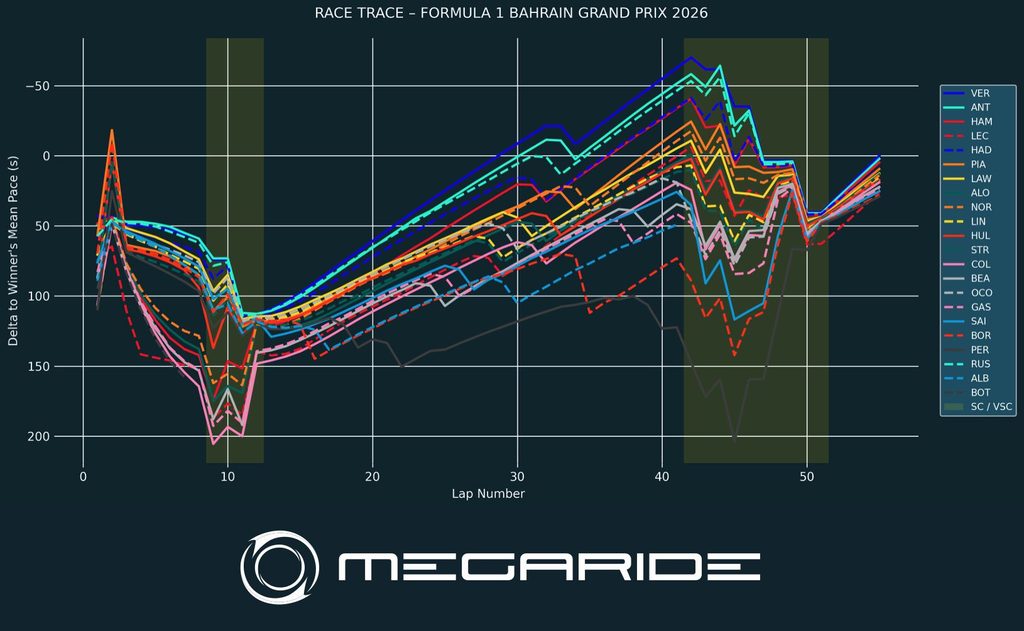
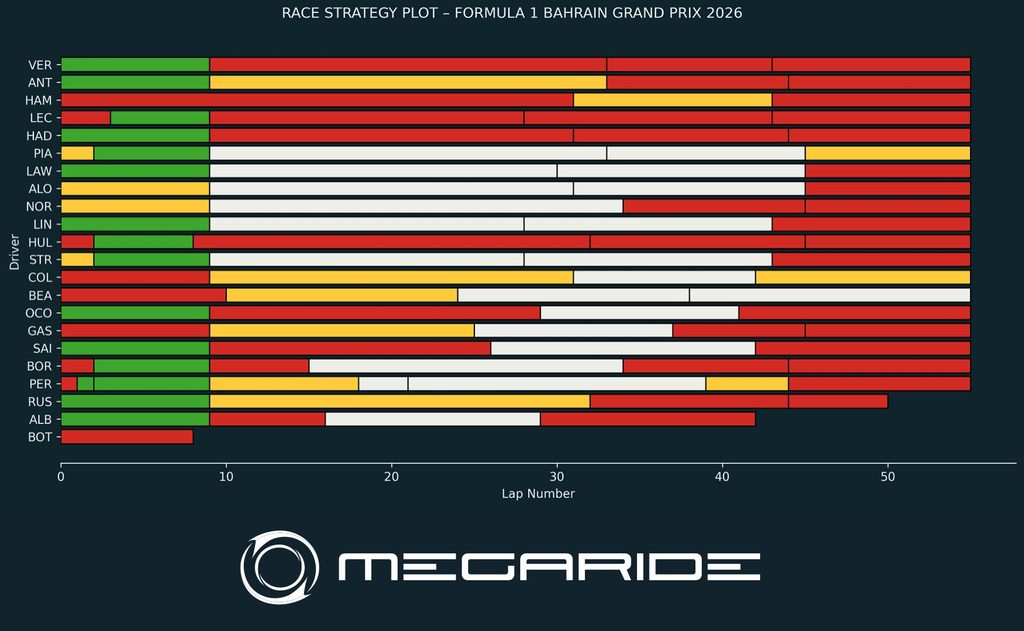
Max Verstappen took his first win of the 2026 season ahead of Kimi Antonelli, second at 2.3 seconds, and Lewis Hamilton, third at 4.9. Weather and neutralisations heavily shaped the race, with rain delaying the start, a Safety Car on Lap 9, and another late neutralisation after Albon stopped. Russell, who had been running in podium contention, retired with a power-unit issue.
The most relevant phase for pure pace comes after the first Safety Car. Verstappen switched from Intermediate to Soft, while Antonelli moved to Medium. After the restart, Verstappen passed the Mercedes and progressively opened the gap, reaching around 5 seconds by Lap 21 and more than 10 seconds before the neutralisation on Lap 43.
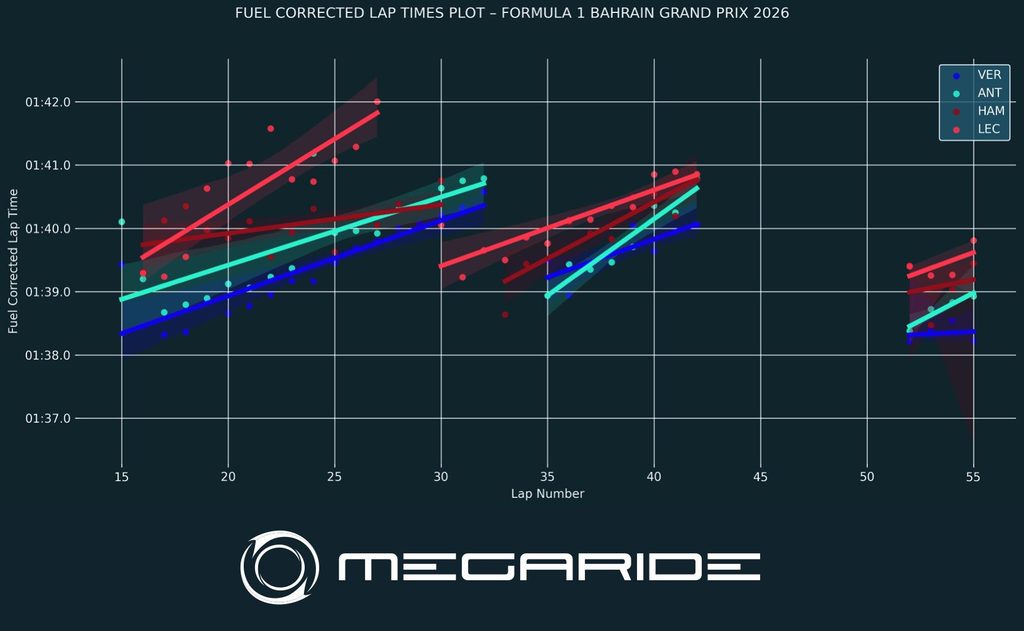
The fuel-corrected analysis helps explain that advantage. Between roughly Laps 15 and 32, Verstappen’s fitted pace moves from about 1:38.3 to 1:40.4, corresponding to an observed increase of around 0.12 s/lap per lap. Antonelli shows a very similar trend on the Medium, close to 0.10 s/lap per lap, but his corrected pace remains roughly 0.4 to 0.6 seconds per lap slower through much of the stint.
This suggests that Red Bull’s main advantage was not a dramatically lower degradation rate, but a lower performance baseline. Verstappen was simply operating in a faster lap-time window while maintaining comparable tyre evolution.
Hamilton provides another useful reference. Once slick conditions were established, his long first Soft stint shows a much flatter corrected trend, moving only gradually through the mid 1:39s to low 1:40s. That points to relatively limited degradation in that phase and helps explain why the Soft remained viable for such a long stint.
Leclerc’s first dry stint should be interpreted more carefully. His corrected lap time rises more sharply, but that phase is also affected by traffic and the consequences of the opening laps. It would therefore be misleading to attribute the full slope directly to tyre degradation.
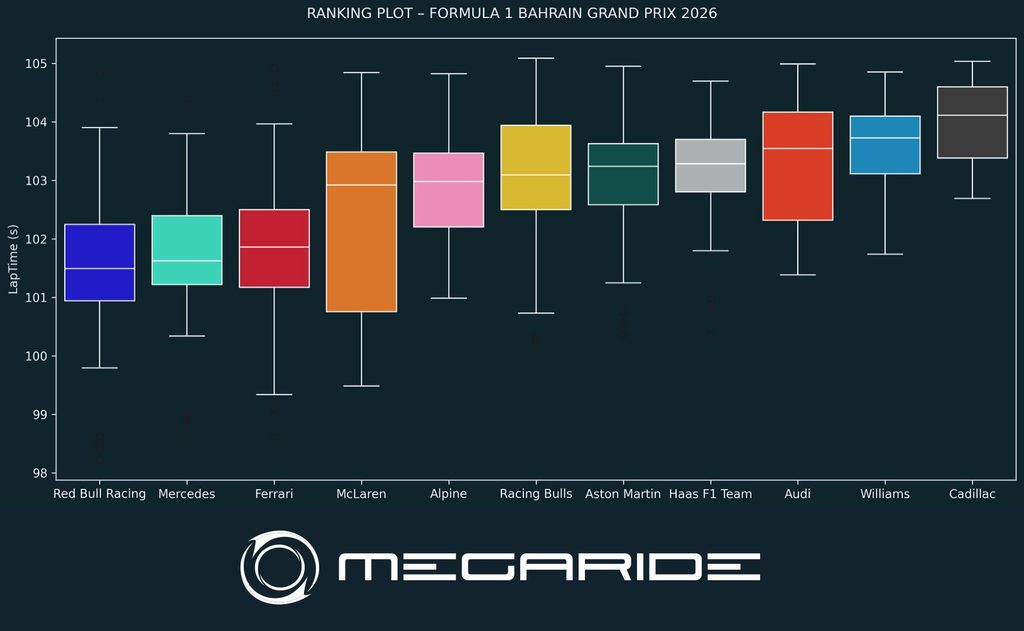
The team median ranking places Red Bull at around 1:41.5, Mercedes at approximately 1:41.6, and Ferrari close to 1:41.9. McLaren is more than one second per lap further back in median pace, although its race was heavily conditioned by strategy and by spending long phases on the Hard.
The late Safety Car erased the gap Verstappen had built, but it did not create the performance advantage. The decisive phase came earlier, when the combination of lower corrected pace, strong Soft performance and consistent tyre behaviour allowed Red Bull to convert the compound choice into track position and race control.