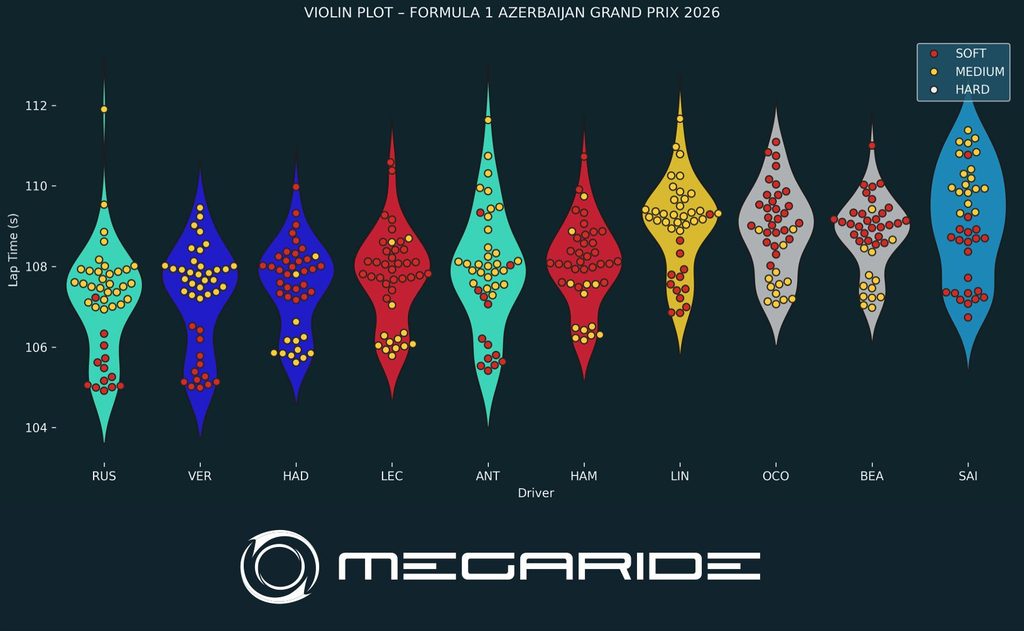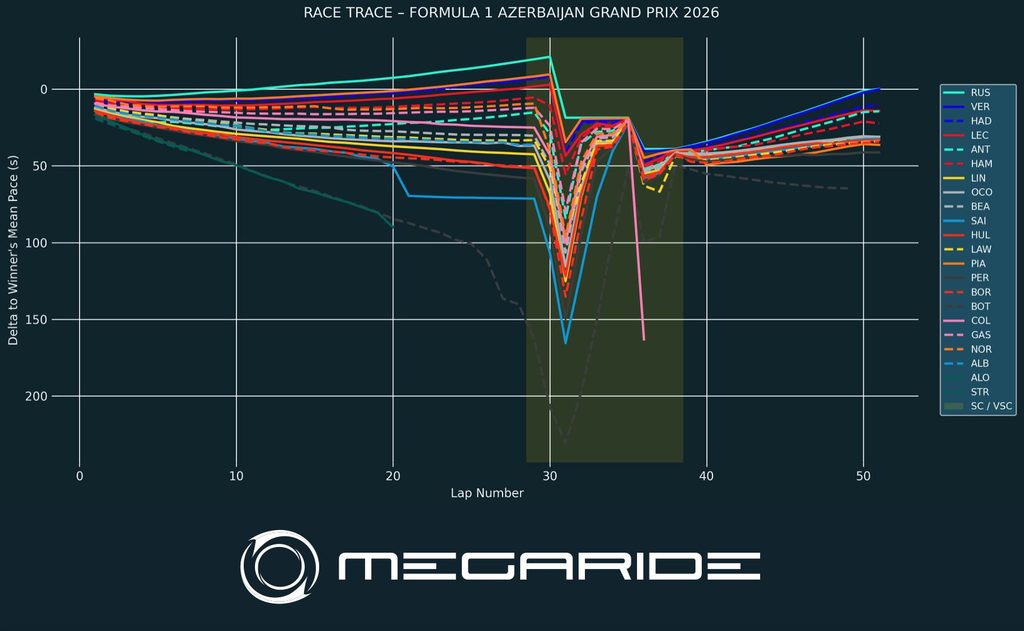
George Russell converted pole into his third win of the season, beating Max Verstappen by only 0.2s. Isack Hadjar completed the podium at +10.7s, with Charles Leclerc fourth. Russell had built a clear lead before two successive Safety Cars compressed the field.
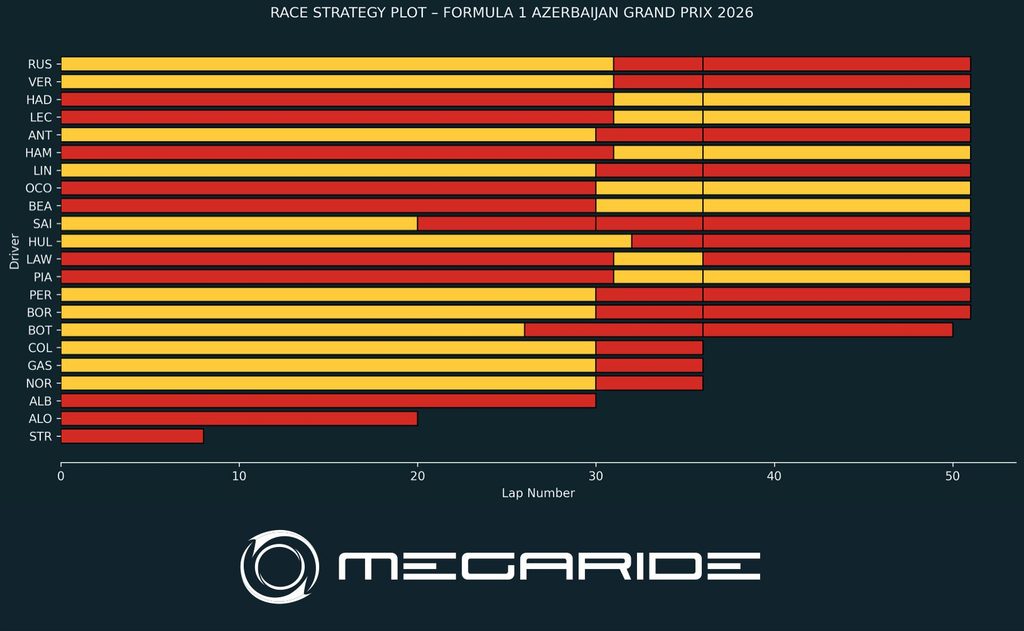
The opening stint already separated pace from compound choice. Russell and Verstappen started on the Medium, Hadjar and Leclerc on the Soft. Russell was nearly ten seconds clear of Piastri around halfway, while Verstappen reported that the Medium lacked grip. Fuel correction reinforces Russell’s advantage: his fitted pace rises from roughly 1:44.8 to 1:45.2 by Lap 30, about +0.01 s/lap, with a steeper trend for the other three.
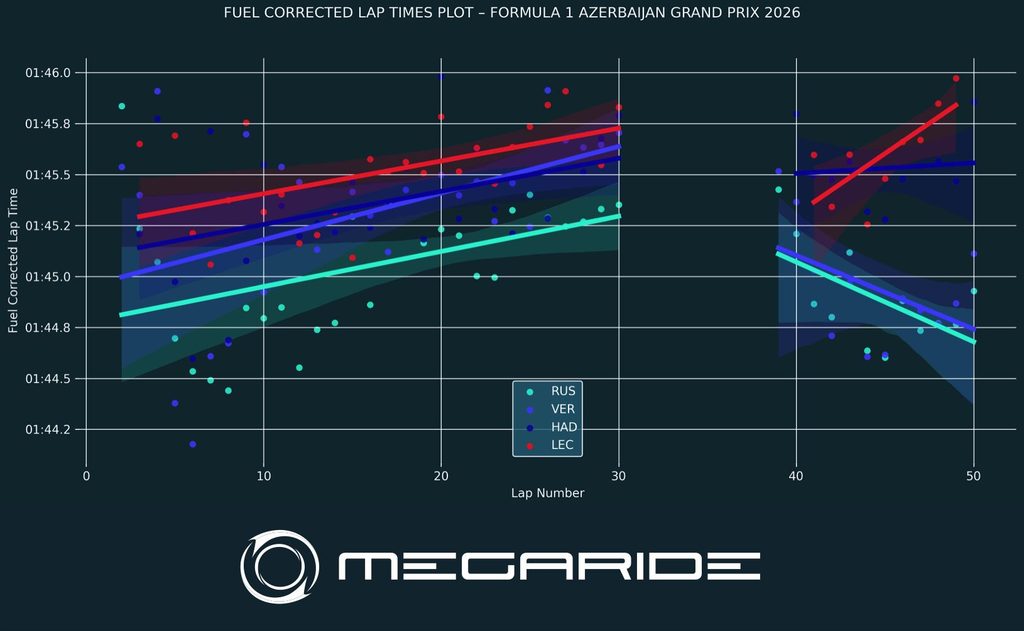
That slope should not be read directly as degradation. Wear on C4 and C5 remained low and no significant graining emerged, allowing teams to extend the opening stint while waiting for a neutralisation.
The first Safety Car then created the most useful comparison. Russell and Verstappen switched Medium to Soft; Hadjar and Leclerc went Soft to Medium. After the restart, Russell and Verstappen improved towards 1:44.7–1:44.8 corrected pace, while Hadjar remained around the mid-1:45s and Leclerc drifted towards roughly 1:45.9. The Red Bull comparison matters: same car, opposite tire sequence, and the gap grows through the stint.
The Soft was not simply a short-life option. In these conditions, it became the stronger race tire. The main restart issue was how quickly the front axle returned to its operating window. Piastri’s race fits that picture: after the second Safety Car he locked up into Turn 1 on the Medium and lost a potential podium, while that compound appeared more difficult to bring back into the right temperature window in that phase.
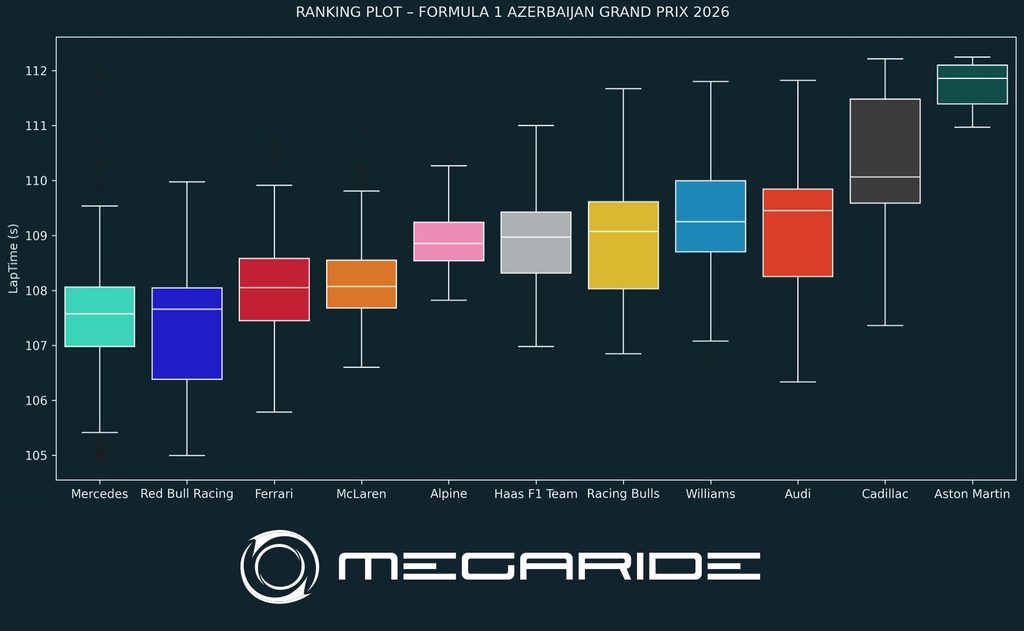
Mercedes and Red Bull are separated by only about a tenth in median lap time, effectively the same performance window relative to the spread. Ferrari and McLaren sit roughly half a second back, although McLaren’s result was distorted by Norris retiring in the restart collision and Piastri’s Turn 1 error.
Russell’s win was not created by the Safety Cars. The lower corrected baseline, the shallowest first-stint trend and the gap built before the neutralisation all point in the same direction. The open question is the late Medium behaviour: Hadjar stabilises, Leclerc fades more clearly, while the Soft runners continue to improve.