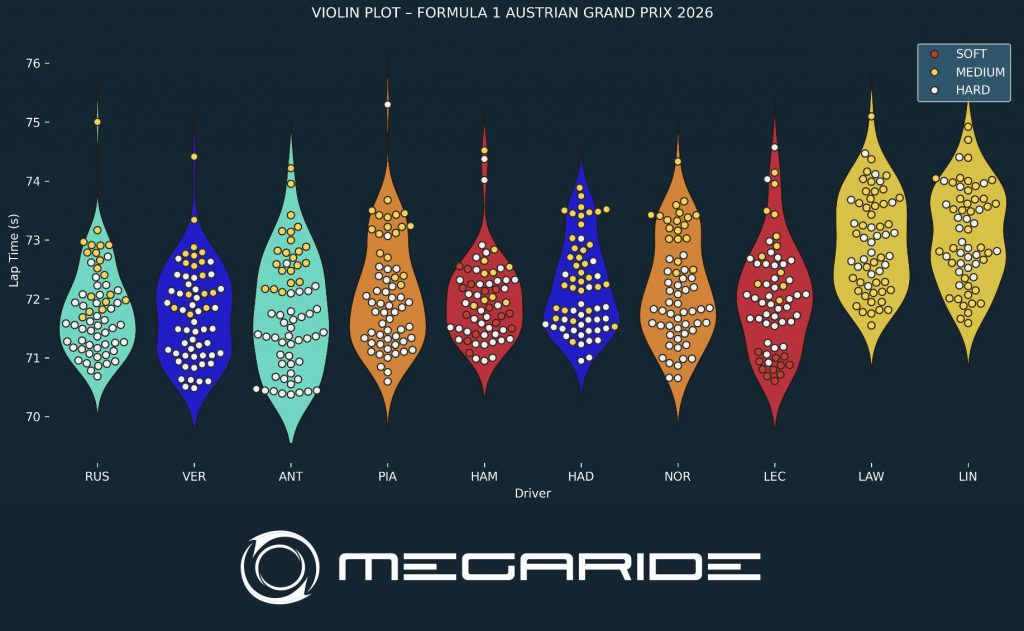
Austria was not a race where the fastest-looking final stint automatically decided the result. On a short lap like Spielberg, the margin between strategy gain and tire-age penalty is small, and that is where Russell’s race was built.
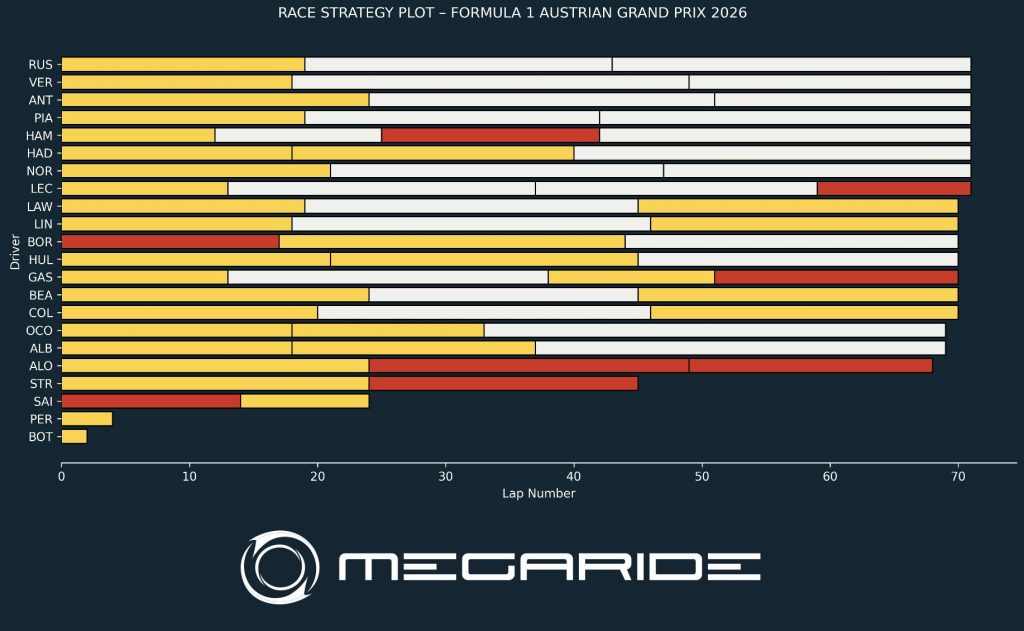
The front group stayed on a similar strategic structure. Russell, Verstappen and Antonelli all started on medium and then completed the race on two hard stints. The difference was mainly in timing: Russell committed earlier, stopping around lap 19 and then again in the low 40s. Verstappen and Antonelli extended the middle stint and therefore had a fresher hard tire for the final phase.
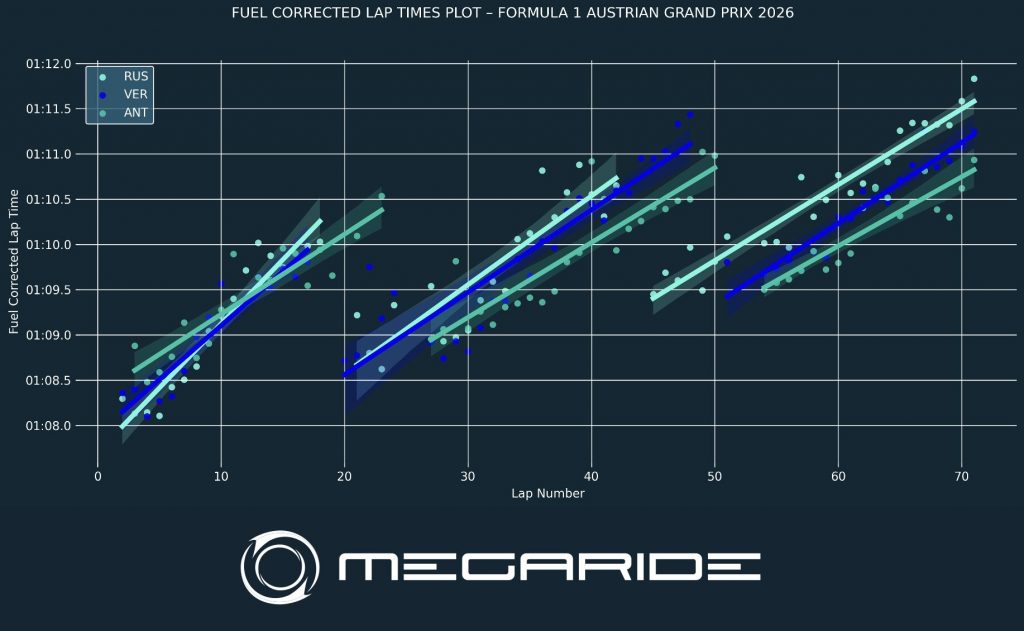
The fuel-corrected lap time plot makes this trade-off quite clear. Russell’s final stint does not appear to be the lowest-degradation one of the three. His trend moves from the high 1:09s towards the mid 1:11s by the end. Verstappen shows a slightly flatter late-race evolution, while Antonelli’s last hard stint is probably the cleanest of the front group.
Estimated final-stint degradation is close rather than extreme: Russell around 0.11–0.13 s/lap, Verstappen roughly 0.10–0.12 s/lap, with Antonelli slightly lower. So the result is more a matter of when the tire performance was available and whether it could be converted into track position.
That is the key point. Russell accepted more tire age at the end, but had already placed the car in the right position before the final offset became significant. Verstappen and Antonelli came back with better tire life, but the advantage was not large enough or early enough to reverse the order.
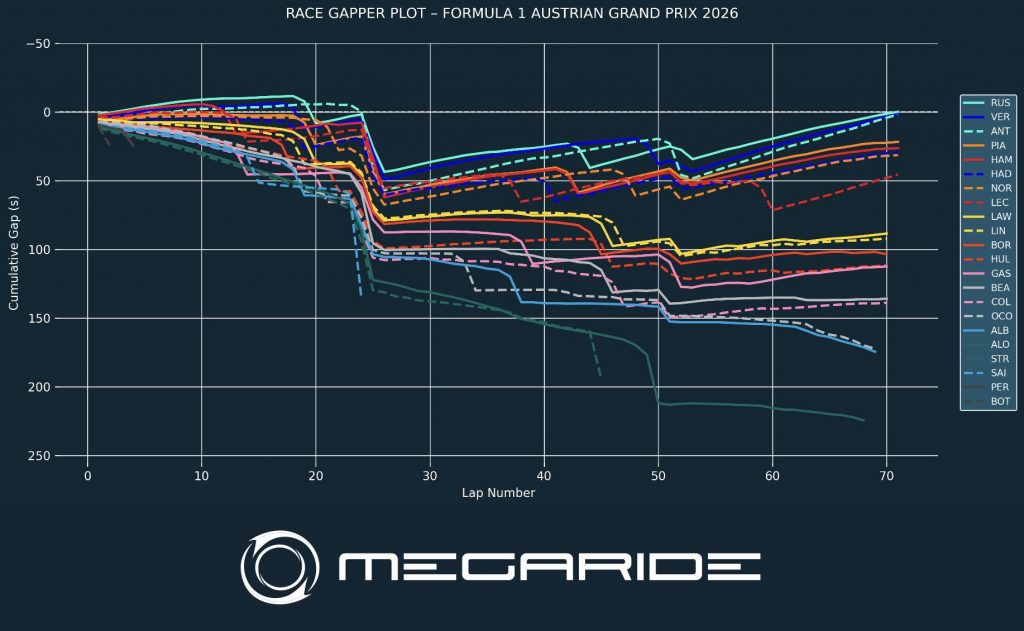
The gapper supports the same reading. The main reshuffling comes around the pit windows, especially between laps 20 and 50. After that, the gaps compress again at the front, but without a complete change in race structure.
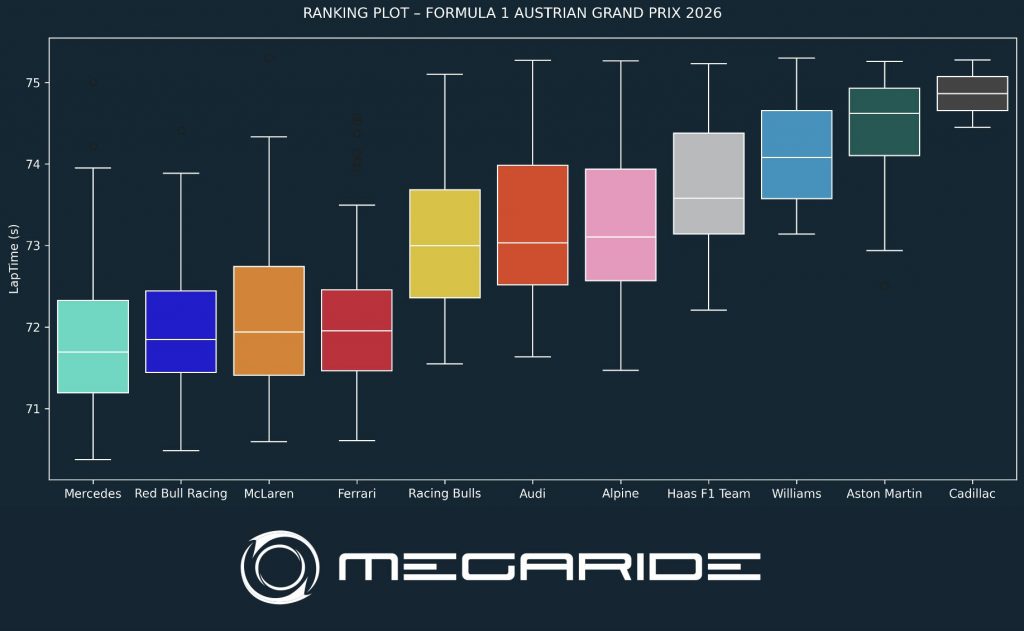
At team level, Mercedes has the strongest aggregate race pace, with a median just below 1:12. Red Bull, McLaren and Ferrari are packed in the same performance band, separated by only a few tenths. Racing Bulls, Audi and Alpine form the next group around the 1:13 region, while the lower midfield moves towards the mid-1:14s.
The violin plot adds a useful detail: Russell’s lap distribution is compact in the low 1:11s / low 1:12s, while Verstappen has comparable peaks but a wider spread. Antonelli’s late pace stands out, although the race had already been shaped before that final run.
In the end, this was a very technical Austria win built on the balance between degradation, pit timing and clean-air execution.