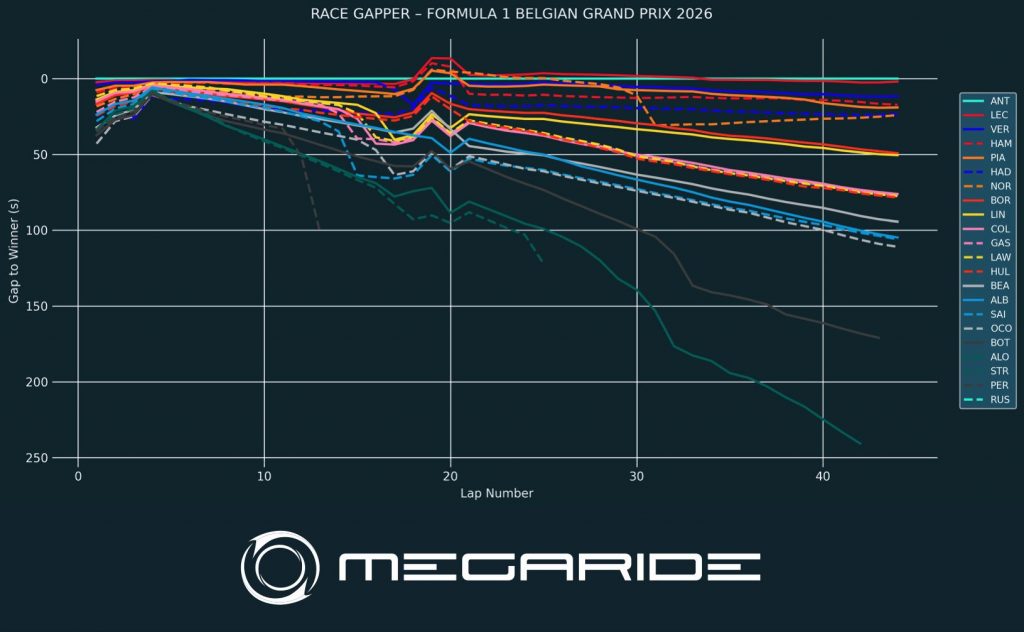
Spa made Antonelli win this race twice. He started from pole, briefly lost P1 to Verstappen, and recovered it before Les Combes. Then the Virtual Safety Car put Leclerc ahead through the pit cycle. With ten laps remaining, Antonelli had to pass the Ferrari on track and keep it behind. The winning margin was 1.9s; for part of the closing phase, it was closer to half a second.
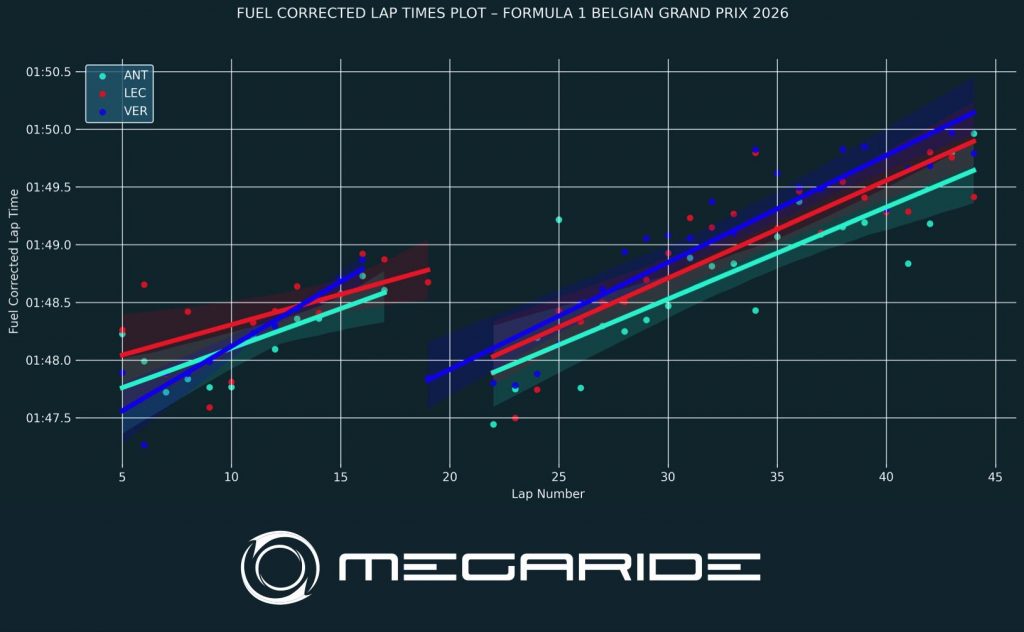
The opening stint explains why the race never fully stabilised. Antonelli, Leclerc, and Verstappen stayed in a narrow window on the medium tire. In the fuel-corrected plot, their trends begin between roughly 1:47.6 and 1:48.0 and reach the high 1:48s near the pit window. Verstappen’s curve rises more sharply, and Antonelli’s is the cleanest, but nobody builds enough margin to remove strategy from the equation.
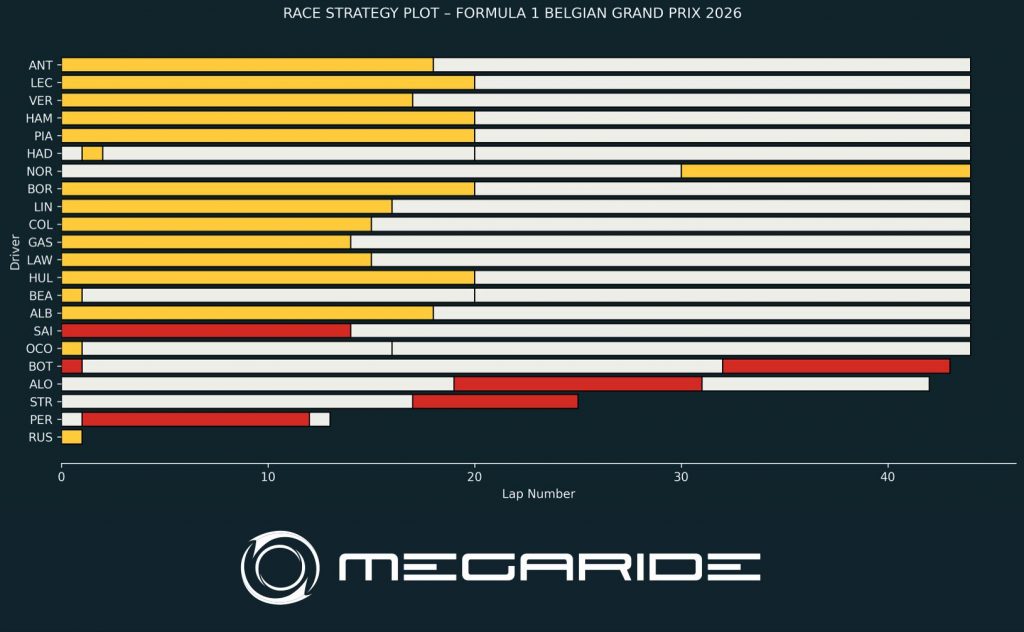
The decisive sequence came between laps 18 and 20. Verstappen stopped first. Antonelli covered him after the initial, short VSC and retained the net lead; a second VSC then gave Ferrari the cheaper stop it needed. Leclerc emerged ahead.
The recovery was shaped more by stint timing than compound choice, as both Antonelli and Leclerc ran the same tire. Leclerc’s slightly fresher set, gained by stopping later, helped him initially maintain track position, but it did not translate into a lasting pace advantage. Antonelli progressively closed the gap and completed the pass around lap 34. His fuel-corrected regression stays generally one to three tenths below Leclerc’s during the second stint, including late in the race. Leclerc remained close at times and kept the Mercedes under pressure, but never created a real opportunity to attack.
Verstappen’s third place followed a different path. He led briefly, passed Leclerc early, and forced Mercedes to react by stopping on lap 18. On the hard, Red Bull could not match the leading pair. The gap opens progressively after lap 30 and reaches 11.5s at the flag; his fuel-corrected trend is also the steepest of the three in the final stint.
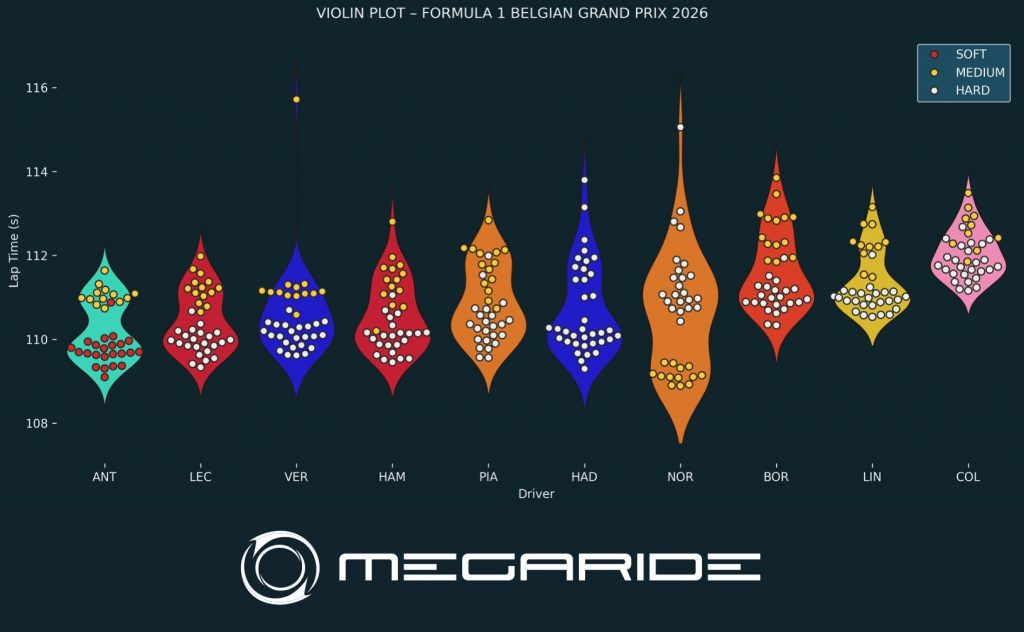
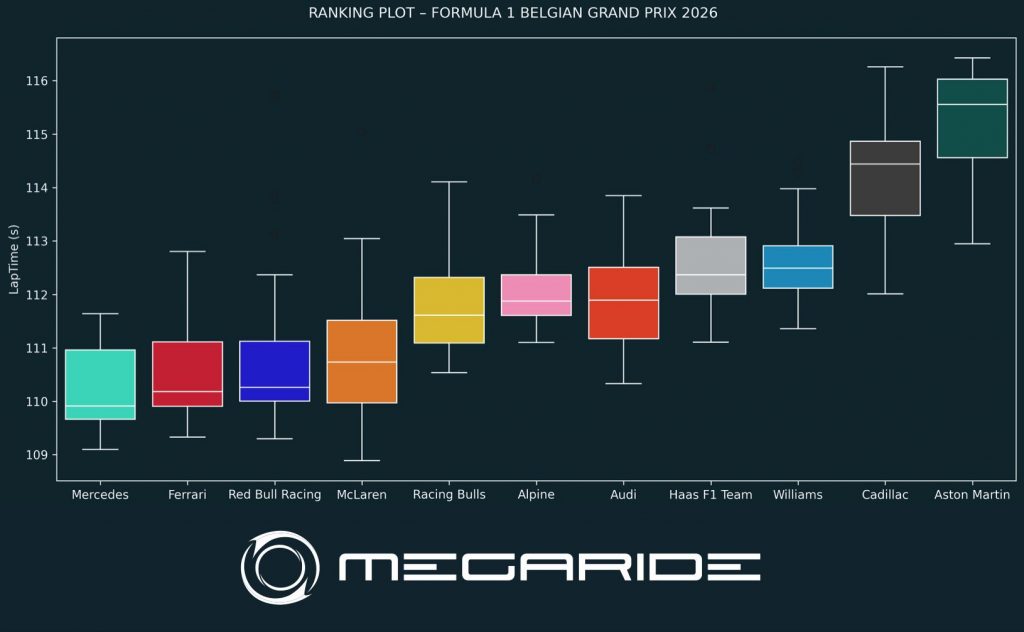
The ranking plot keeps the margins clear. Mercedes has a median around 1:49.9, Ferrari 1:50.2 and Red Bull 1:50.3; McLaren follows at roughly 1:50.7. Mercedes’ sample is effectively Antonelli alone after Russell retired on lap one, so this is not a clean two-car comparison. The quickest package still takes the win, without controlling every phase from the front.
Antonelli secures his sixth win of the season and joins the group of drivers who take their first Monaco and Spa victories in the same year. For 2026, Russell’s first-lap retirement leaves him 50 points behind. Hamilton becomes the closest challenger, 45 back.