F1 BARCELONA-CATALUNYA GP 2026 | Hamilton wins it through stint pace
Hamilton’s race came together through pace, tire control and a three-stop strategy timed around the VSC. He started on soft, switched to hard, ran the medium in the middle phase and returned to hard around lap 41. That final stop cost less under Virtual Safety Car conditions and allowed him to rejoin ahead of Russell and Norris on a much fresher set. From there, he controlled the last stint and finished roughly twenty seconds clear of Russell.
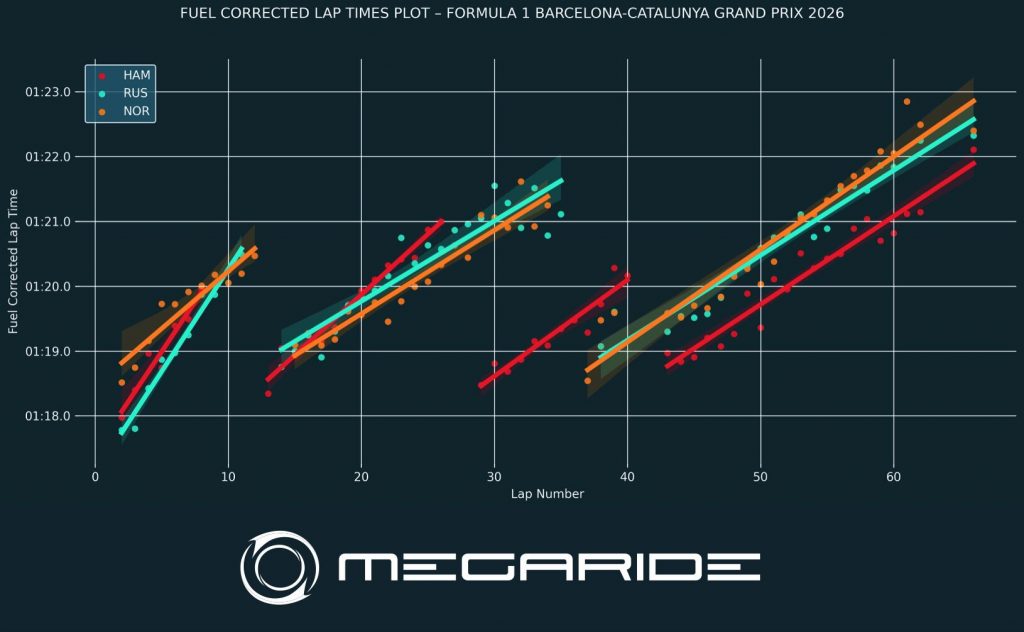
The fuel-corrected plot shows how the race developed. Early on, Hamilton, Russell and Norris are close, mostly between 1:18 and 1:21 as the first sets age. The gap opens on the final hard stint. Hamilton’s fitted trend begins below 1:19 and rises to just under 1:22 by the flag. Russell runs around two to five tenths slower through much of the same phase, while Norris shows the steepest late-stint increase and ends close to 1:23.
Hamilton’s degradation rate in that final stint is roughly 0.13–0.14 s/lap. Russell is nearer 0.16 s/lap, Norris around 0.17–0.18 s/lap. The fresh hard gave Hamilton a lower starting offset and a flatter progression, enough to turn the VSC window into a decisive advantage rather than simply recover the extra pit stop.
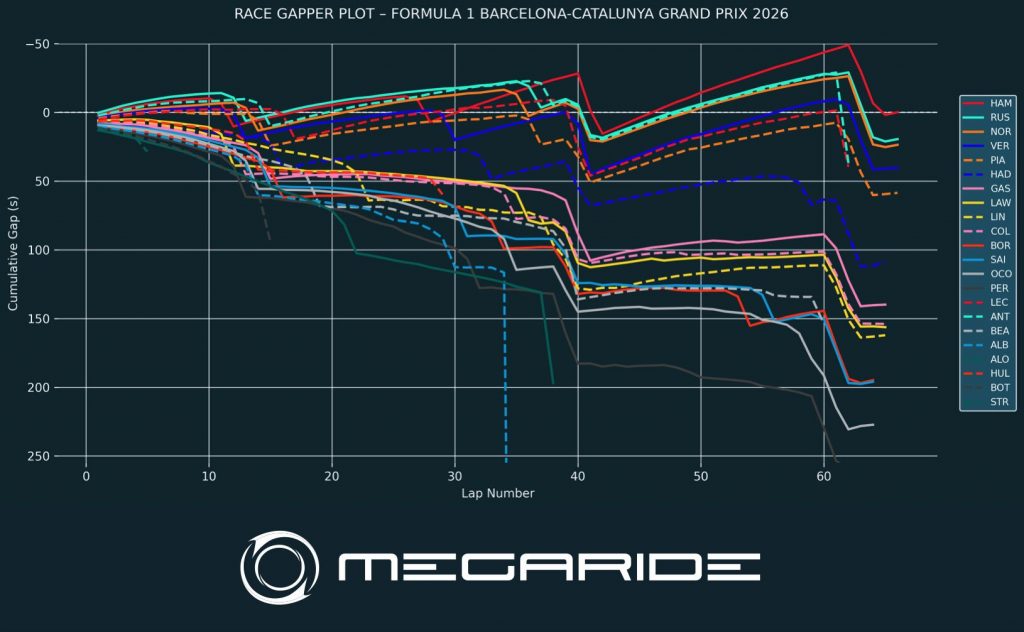
The gapper makes the strategy easier to read. Each pit cycle reshapes the order, yet Hamilton rebuilds the margin every time. Russell and Norris remain in the same performance group; Verstappen falls towards the forty-second region and Piastri approaches one minute by the end. The late sequence exaggerates some of the final gaps, but the race had already moved in Hamilton’s direction before the last phase.
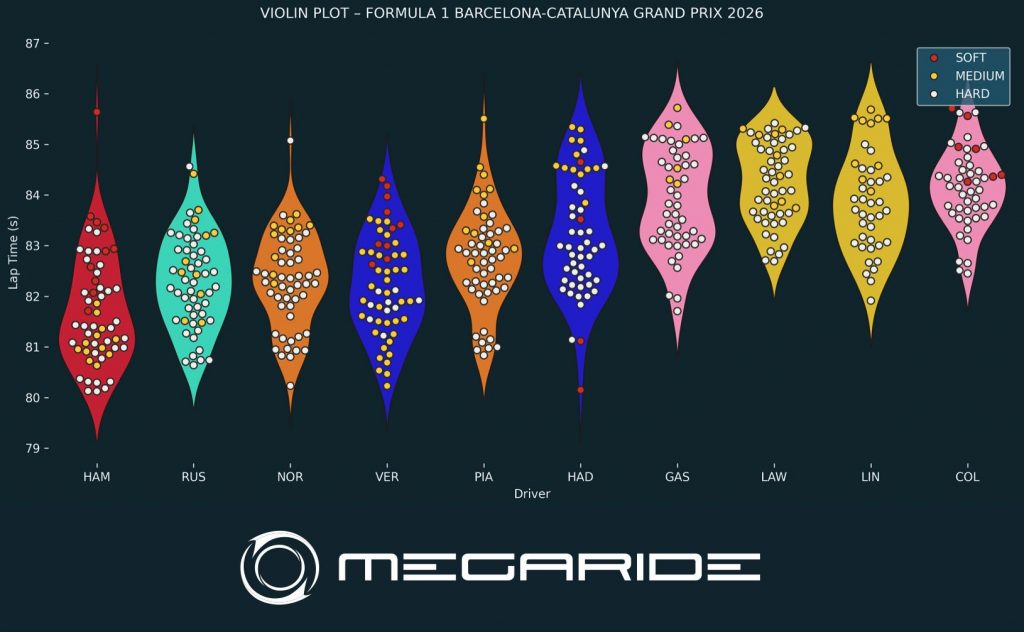
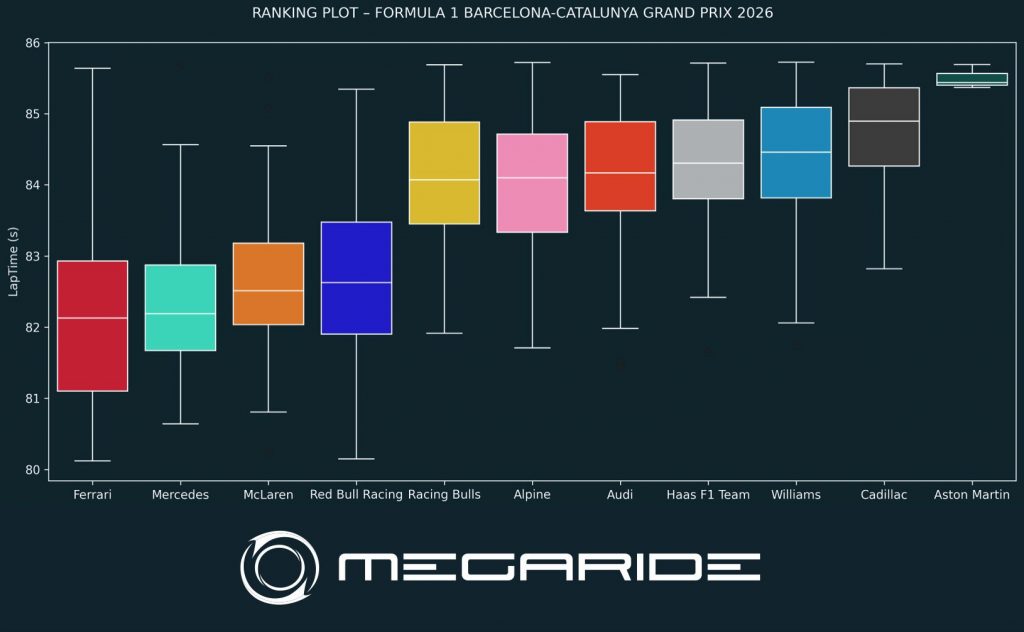
Ferrari also leads the aggregate ranking plot, with a median close to 1:22.1. Mercedes is almost level, McLaren sits around 1:22.5 and Red Bull slightly higher. Since the box plot combines both drivers, compounds and stint lengths, the violin distributions are useful here. Hamilton has a strong concentration of laps around 1:20.8–1:21.4, plus another dense area near 1:22.7–1:23.2. Russell and Norris spend less time in the quickest band and their distributions are shifted upwards.
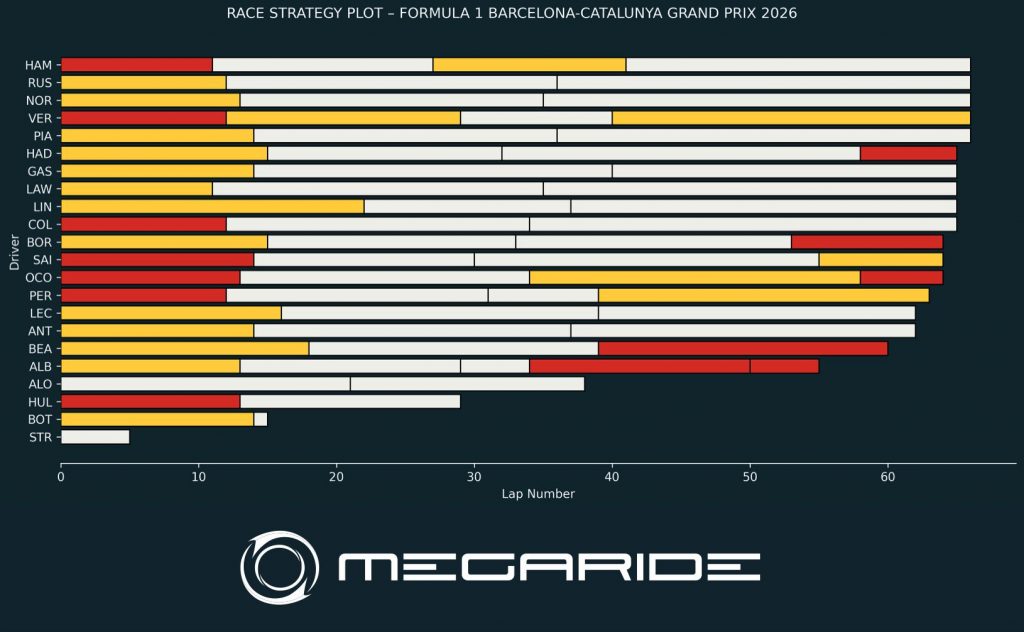
For Hamilton, this was a huge win. His first for Ferrari came after a long wait, and it arrived with a race that demanded commitment from both driver and pit wall. Ferrari was quicker than expected in Barcelona, took the VSC opportunity without hesitation and had the pace to make the aggressive strategy work. Hamilton finished it with an excellent final stint.